
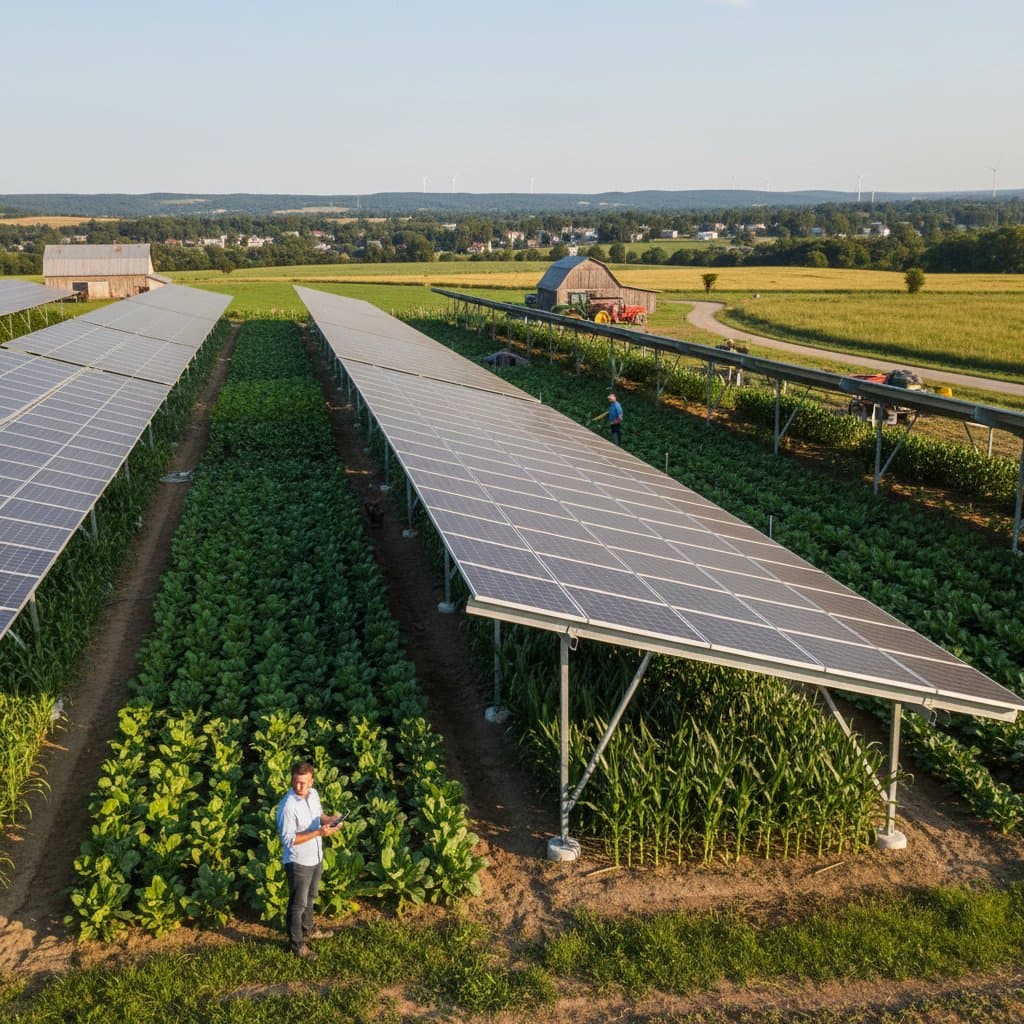
Agrivoltaics: Doubling Farm Income While Preserving Crop Production
Farmers confront narrowing profit margins, erratic weather patterns, and escalating energy expenses. Numerous producers seek reliable strategies to secure income stability without compromising land productivity. Agrivoltaics, also termed dual-use solar farming, emerges as a promising solution by enabling land to yield both crops and renewable energy. This method reshapes rural landscapes and holds the capacity to double farm revenues without diminishing food output.
Core Principles of Dual-Use Solar Farming
Agrivoltaics merges photovoltaic systems with operational farmland. Panels mount at elevated heights and strategic intervals, permitting sunlight to penetrate to the underlying soil. Producers maintain cultivation of vegetables, grains, or grazing areas while deriving income from energy production. The land thus supports dual revenue sources: traditional harvests and proceeds from power generation or leasing arrangements.
This framework proves particularly advantageous in areas with premium land values or limited available acreage, where optimization of each parcel becomes essential. For operators in the Philadelphia vicinity and throughout Pennsylvania, dual-use solar farming enhances operational resilience and financial viability.
Essential Safety Considerations in System Design
All dual-use solar installations adhere to rigorous electrical safety standards. Prior to deployment, verify that wiring configurations, grounding mechanisms, and connectors comply with approvals from the local authority. Equipment bears certifications from accredited laboratories like UL or ETL. Should exposed wiring or unsecured junction boxes appear, halt operations immediately and engage a licensed electrician. Refrain from manipulating compromised cables or inverter connections absent specialized training.
Farmers employ specific protective equipment during inspections or maintenance of solar elements:
- Non-contact voltage tester
- Insulated gloves
- Safety glasses
- Lockout/tagout kit for circuit isolation
- Torque screwdriver to ensure secure terminals
Persistent tripping of GFCI or AFCI breakers, along with signs such as burn marks, unusual noises, or fractured panel glass, necessitate immediate disconnection and consultation with a qualified solar professional. Conduct routine visual assessments and torque verifications to mitigate risks of overheating or arcing.
Generating Dual Revenue Streams
Financial gains arise through revenue diversification. Landowners leasing space to solar developers secure consistent payments via extended contracts. System owners produce electricity for farm consumption or grid export, thereby lowering utility expenditures and yielding steady returns.
Crops beneath panels experience moderated microclimates. Research indicates that intermittent shading alleviates heat stress, potentially elevating yields for shade-tolerant varieties like lettuce, spinach, and berries. In livestock settings, shaded zones under panels facilitate grazing, which prolongs pasture vitality and reduces supplemental feed requirements.
Environmental and Practical Advantages
Dual-use solar farming preserves soil hydration by curbing evaporation rates. Reduced light exposure fosters cooler soil conditions and safeguards microbial communities. Inter-row planting of pollinator habitats bolsters bee and butterfly populations, improving pollination for adjacent fields.
In contrast to traditional solar developments that idle farmland, agrivoltaics sustains active use. Panels function as adaptive barriers against climate variability, aiding sustained productivity amid shifting conditions. Operators frequently observe enhanced water efficiency and diminished irrigation needs. Additionally, the setup minimizes wind erosion and airborne particulates, thereby prolonging the durability of farming implements.
Navigating Planning and Permitting Processes
Agrivoltaic initiatives demand meticulous alignment with municipal zoning entities and the Pennsylvania Department of Environmental Protection. Permits address structural elevations, stormwater management, and electrical integrity. Designs accommodate equipment pathways for sowing and reaping activities. Panel arrays typically feature expanded spacing relative to large-scale solar farms to allow tractor or animal passage.
Prior to finalizing agreements, farmers execute these steps:
- Obtain a comprehensive site plan detailing panel elevations, inter-row distances, and pathways.
- Examine the electrical one-line schematic and validate the grid connection location.
- Confirm adherence to the National Electrical Code alongside regional modifications.
- Secure documentation of installer insurance, bonding, and credentials.
- Arrange third-party verification post-installation to affirm regulatory compliance.
Engage a certified solar engineer to simulate energy output and evaluate shading effects on vegetation. Such evaluations yield precise forecasts of combined income potential.
Selecting Technologies and Upholding Maintenance
Contemporary agrivoltaic setups incorporate dynamic or solar-tracking mounts that adjust panel angles throughout daylight hours. These configurations optimize crop illumination while maximizing power yield. Certain installations feature integrated sensors tracking soil hydration and thermal levels, relaying insights to agricultural software for refined irrigation and varietal choices.
Sustained upkeep remains critical. Clean panels using gentle brushes and water, eschewing harsh abrasives. Perform yearly wiring reviews and ground-fault circuit testing. Maintain a detailed log of all upkeep procedures. Address erratic voltage or inverter alerts by summoning a certified specialist, avoiding self-repairs.
Projections for Economic Viability and Community Effects
Projections suggest that integrated solar-agriculture operations may double net farm earnings as crop and energy incomes equilibrate. The synergy of curtailed energy costs, assured leasing income, and fortified crop durability establishes a robust enterprise framework. Regional economies gain from employment in construction, ongoing servicing, and greater energy autonomy.
In Philadelphia-adjacent communities, agrivoltaics advances clean energy objectives without eroding agricultural traditions. Producers retain stewardship roles over their holdings, forestalling conversion to non-farm uses. This evolution fosters partnerships among utilities, farming organizations, and environmental advocates.
Advancing Toward Implementation
Prospective adopters initiate with thorough site appraisals, gauging insolation levels, soil composition, and vulnerability to inundation. Consult local extension services or Pennsylvania solar associations for expert counsel. Solicit bids from contractors experienced in agrivoltaic deployments, beyond conventional installations.
Evaluate fiscal scenarios contrasting ownership and leasing options. Ownership promises superior long-term gains yet entails initial investments and upkeep duties. Leasing simplifies oversight with minimized exposure to variability.
Following approvals and deployment, institute biannual inspection routines. Log energy performance and harvest metrics to quantify enhancements.
Agrivoltaics demonstrates the compatibility of renewable power and farming practices. Through vigilant safety protocols, regulatory observance, and expert guidance, producers safeguard their acreage, uphold output levels, and establish dependable supplementary earnings while advancing regional clean energy initiatives.