
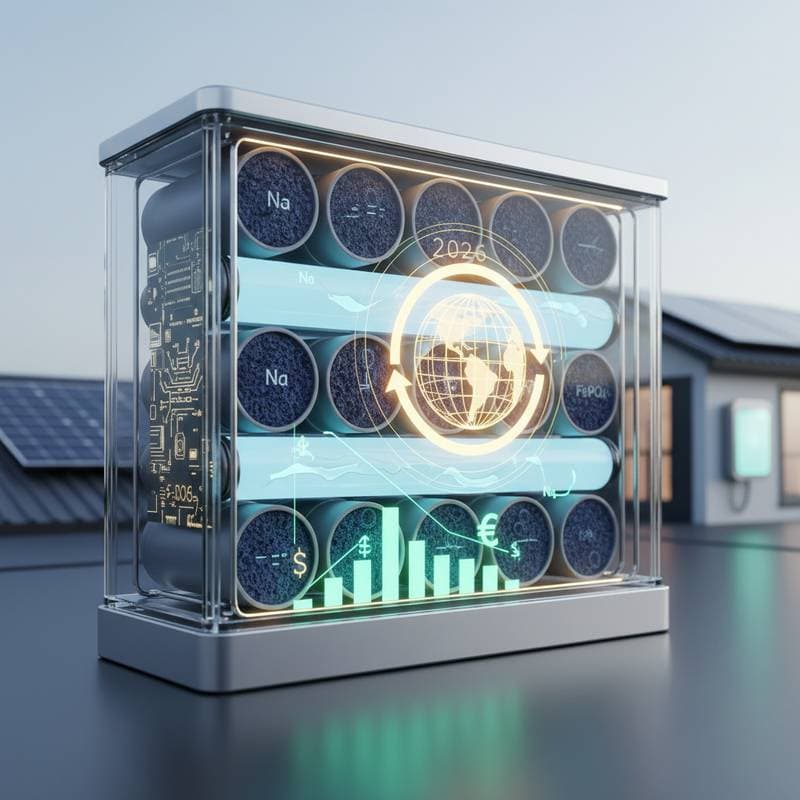
Sodium-Ion Batteries Offer Lower Cost Grid Storage by 2026
Homeowners exploring solar options often ask whether new battery technologies can reduce expenses while improving reliability. Sodium-ion batteries stand out as a practical solution for grid and residential storage. They rely on widely available materials that lower production expenses and enhance safety compared with traditional options.
Advantages Over Lithium Based Systems
Lithium ion batteries power many devices and vehicles today. Their production strains water resources and concentrates supply in limited locations. Sodium ion designs use sodium drawn from common salt deposits found globally. This shift cuts raw material expenses by more than half.
Sodium cells also resist overheating during operation. They tolerate charging variations better than lithium counterparts. These traits suit large stationary installations where stability takes priority over compact size.
Basic Operation and Capacity Details
Sodium ions travel between the cathode and anode through an electrolyte during charge and discharge cycles. The ions are larger than lithium ions, which slows movement and reduces energy density slightly. Grid applications accept this limit because cost and longevity matter more than weight.
Current prototypes achieve 100 to 160 watt hours per kilogram. Daily cycling in home systems remains economical because the price per kilowatt hour stored offsets the modest density difference.
Projected Pricing and Lifespan
Scaled production places sodium ion costs between 40 and 60 dollars per kilowatt hour. Lithium systems currently range from 100 to 140 dollars for similar capacity. A utility project storing 10 megawatt hours could save several hundred thousand dollars by adopting sodium technology.
Residential packs may reduce total solar storage installation costs by 20 to 30 percent. Many designs reach 3000 to 5000 full cycles before capacity falls to 80 percent. This performance supports 10 to 15 years of regular household use.
Best Applications for Stationary Storage
Sodium ion batteries suit community solar arrays, microgrids, and backup power for commercial sites. Size and weight constraints matter less in these settings. Homeowners gain access to affordable solar plus storage packages that manage outages and lower peak utility charges.
Sustainability and Recycling Aspects
Sodium occurs naturally in large quantities and poses minimal toxicity risks. Extraction and end of life processing create smaller environmental footprints than lithium or cobalt mining. Some versions incorporate hard carbon derived from agricultural waste, which further lowers production emissions.
Steps to Ready a Home System
Select an inverter rated for multiple battery chemistries during initial solar installation. Confirm that the system allows future battery additions without full replacement. Monitor manufacturer updates on residential sodium ion releases and consider modular battery enclosures that accept later upgrades.
Ongoing Care for New Storage Units
Review charge levels through monitoring software on a regular schedule. Maintain clear airflow around battery cabinets and arrange annual professional checks of connections. Position units away from direct sunlight and extreme temperatures. Shift high energy tasks such as laundry to daylight periods to maximize self consumption from solar panels.
Communities that adopt these storage advances support steadier renewable integration across the grid. Households gain practical tools for managing energy costs while advancing broader clean power goals.